
The future of SaaS: from products you adapt to, to products that adapt to you
Over the last few months, I've built lightweight personal alternatives to tools I already pay for. Grammarly. Meeting transcribers. Speech-to-text apps. Not because I'm a developer who loves building things — but because a custom version was faster and cheaper to create than convincing the original product to work the way I needed.
I've also watched others do the same with Notion, Jira, and other enterprise staples.
This is becoming a pattern, and it points to something significant.
The uncomfortable question every SaaS product now faces
As software development becomes cheaper, faster, and more accessible, every SaaS product has to answer: why should someone keep paying for a product that doesn't work exactly the way they need, when building a custom version is becoming easier?
Two forces are driving this:
- Lower cost — AI-assisted development collapses the time and money required to build functional alternatives
- Better fit — a bespoke tool, even a rough one, is often a better match for a specific workflow than a polished but rigid product
Of course, building a prototype isn't the same as maintaining secure, reliable, integrated software at scale. But that's not the real threat.
The real threat is the expectation shift
Once users get used to software adapting around their workflows, static products start to feel broken.
The SaaS products with strong moats — deep data, network effects, compliance requirements, enterprise distribution — will have protection from this shift. But products without those advantages need another reason for users to stay.
That reason will be customisation.
What this looks like in practice
Here's my prediction for how this unfolds:
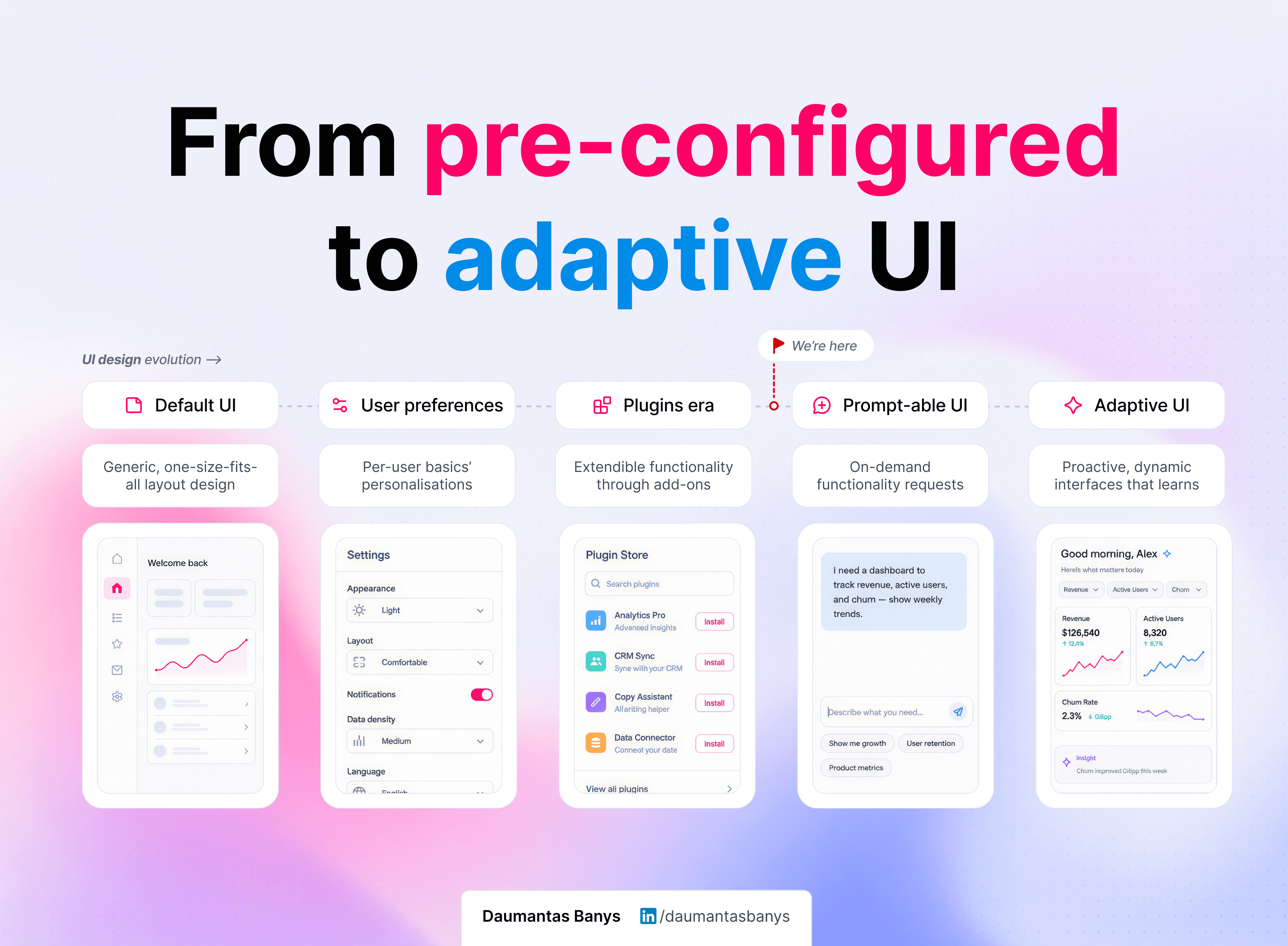
🚩 Phase 1 — on-demand customisation: Major apps will let you customise their interfaces, workflows, and features simply by prompting. Ask Slack to create a poll directly in the thread. Ask your analytics tool to rearrange your dashboard for your role. The feature is generated on demand.
🚩 Phase 2 — proactive adaptation: Products will go further. They'll learn from how you actually work, and suggest changes proactively. After noticing you check the same post for engagement every morning, your social platform surfaces a personalised performance banner. You never had to ask.
The result: each of us may end up using a different version of the same product — with layouts, workflows, and functionality adapted to how we specifically work.
This isn't entirely new
Product customisation has existed for years — plugins, add-ons, extensions, settings. But those solved broad problems for broad user groups. You had to fit yourself to the available options.
The next layer is personal: custom add-ons, generated on demand, for your specific use case, without leaving the app. The customisation target is you, not a user segment.
What this means for builders
If you're building a SaaS product today, the question is no longer whether to offer customisation — it's how deep it goes and how fast it gets there.
Products that get there first create a new switching cost: I can't leave because it's already moulded to how I work.
Products that wait until the expectation has shifted will find themselves on the wrong side of a gap they can't close quickly.
Daumantas Banys is the founder of slicer.dev — a Chrome extension that extracts real web components as AI-optimized prompts for vibe coding tools.


