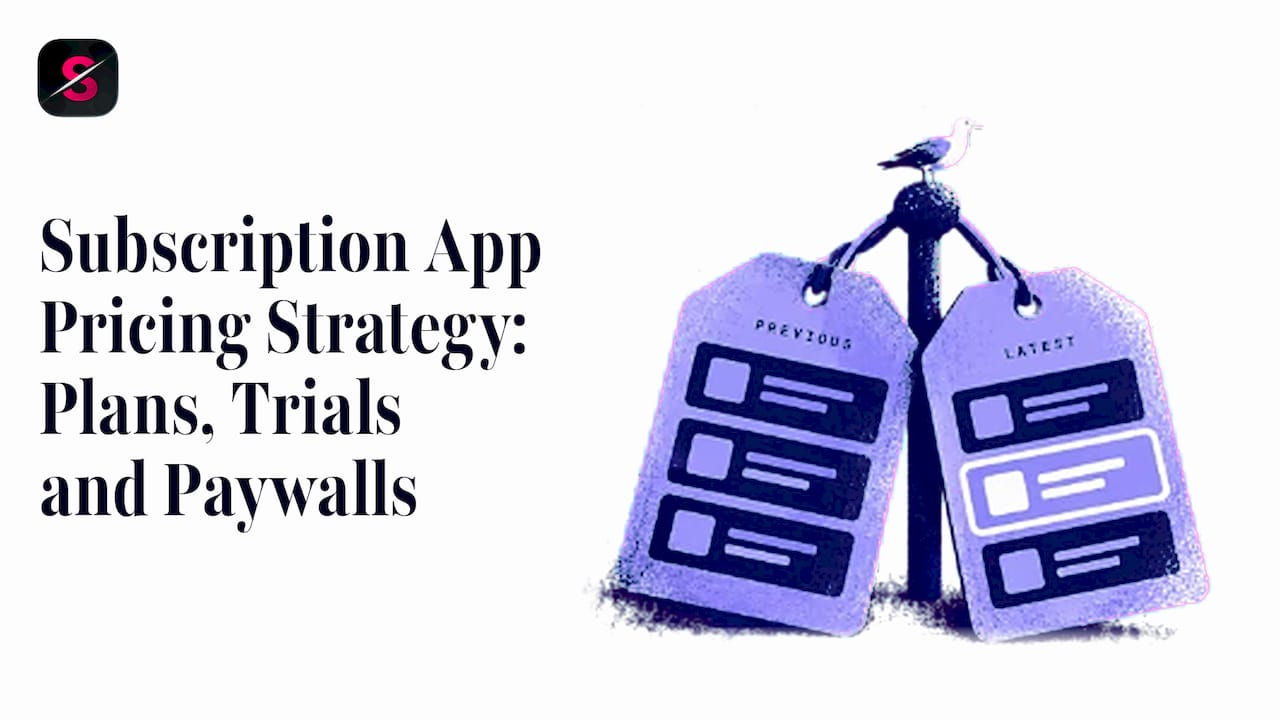
Subscription App Pricing Strategy: Plans, Trials and Paywalls
A subscription app pricing strategy is four decisions: which plans you sell, at what price points, with which trial or discount, and how you prove a change worked. The fastest way to get the first three right is to see what the apps in your category actually show at the paywall, then test your own version. You can’t read a competitor’s paywall from an ad library. You have to follow the funnel through the quiz to the paywall, and that is what Slicer Competitor Watch captures: ad, landing page, quiz, paywall and follow-up emails, with dated screens.
Key Takeaways
-
Choose the model from your product’s value pattern, not from what a competitor happens to charge.
-
Test one variable at a time, define success before you start, and judge the result on revenue per visitor, not conversion alone.
-
Trial length, plan order and the default plan are pricing decisions as much as the price number is.
-
Competitor paywalls are free research: dated captures show which offers and defaults a category keeps running.
-
Ad spend figures for competitors are estimates from captured ads, so use them for scale, not for accounting.
Start with the model, then the price
Most teams pick a model by copying someone else. Chargebee argues this is why so many end up with a model that fits another company’s business, and suggests naming the friction (billing logic, buyer trust, forecasting) before committing, in its Fit-Friction-Lift framework.
A practical way to map product to model, following AppDrift’s guide:
-
Free plus paid features: the free version does a useful limited task and there is a clear reason to upgrade.
-
Subscription with a trial: value takes time or repeated use to judge. Most habit, fitness, nutrition and wellbeing apps sit here.
-
Paid access without a trial: the output and price are understandable before purchase.
-
One-off or usage-based purchase: occasional work or a discrete deliverable. Usage-based means the customer pays for what they consume, such as scans, exports or credits.
The same guide warns that a category label such as fitness does not decide the billing model, and that a price users accept can still lose money if serving them costs more. Check delivery cost, support load, acquisition cost and refunds alongside what customers say the outcome is worth.
Avoid decoy tiers and artificial limits whose only job is to push people into the middle plan. They tend to show up in the paywall as clutter, and they are hard to defend when someone asks why the plans differ.
Set price points in the right order
Price testing goes wrong when teams jump straight to fine-tuning $9.99 against $10.49. Retention.Blog’s price-testing playbook recommends a sequence:
-
Confirm the price is roughly right.
-
Optimise packaging and duration. Changing the monthly price while holding the yearly price constant can shift a lot of buyers to annual, and a higher annual share is one of the biggest wins.
-
Fine-tune once you know the range and the structure. Lower-volume apps should leave this step for later.
For a first range, look at what your category’s paywalls already show. BetterMe’s funnel is a useful reference: the paywall presents the plan as a daily price, €0.49/day, and preselects a “Most Popular” plan. Those are two separate choices (how the price is framed and which plan is the default), and each can be tested on its own. You can see the whole sequence in the BetterMe quiz funnel case study, which covers a 48-screen relationship quiz, 16+ quiz funnels and roughly €168.5k of estimated EU/UK lifetime spend on captured ads. That spend is an estimate based on the ads captured, not a reported figure.
Trial offers: length, type and where they sit
A trial is a pricing decision because it changes when the customer first pays. On the App Store, Apple lets you set up three types of introductory offer: a free trial, pay up front (a discounted fixed price for a set period) and pay as you go (a discounted price for each billing period of the offer).
Length matters. A summary of RevenueCat’s State of Subscription Apps reports that trials of 17 to 32 days converted at 42.5%, against 25.5% for trials of four days or fewer. That does not mean longer is always better for you. Purchasely recommends matching trial duration to the app’s learning curve: a meal-planning app that needs a week of use to show results has a different answer from a meditation app whose value lands in one session.
Paid trials are another pattern worth knowing. A software product that offers a $1 seven-day trial with no limits is trading free-trial volume for a stronger signal of intent. Whether that suits an app depends on how much of your funnel is cold paid traffic.
In web-to-app funnels the trial offer usually appears after the quiz, so the quiz does part of the selling. Noom’s funnel is a clear example. In our Noom case study, captured on 23 October 2026, the funnel runs to 38 screens, 94% of the 101 Meta ads captured lead to the weight-loss quiz, and estimated spend in Germany and Austria is about €160.1k. Again, that is an estimate from captured ads. The lesson for pricing: by the time the offer appears, the visitor has spent several minutes describing themselves, so the offer can refer to their answers.
Discount paywall tactics that hold up
Discounts raise conversion quickly and are easy to overuse. These patterns are worth testing, each with a guardrail:
-
Frame the price per day. BetterMe’s €0.49/day framing makes a monthly or longer plan feel small. Guardrail: the full billed amount must still be clear on the same screen.
-
Preselect the plan you want to sell. BetterMe highlights a “Most Popular” plan. Guardrail: only label a plan that really is the best fit for most buyers, or you are creating the decoy problem described above.
-
Put proof where doubt appears. BetterMe places reassurance next to the decision, not on a separate page. Guardrail: use real results and testimonials.
-
Show the plan taking shape before asking for an email. BetterMe gives a personal result first and builds the plan visibly, so the payment step feels like the next stage of something already started.
-
Keep follow-up discounts for people who leave. A reminder email with a lower price should reach people who didn’t convert, not train every visitor to wait. Competitor Watch saves follow-up emails, so you can see how often a category sends them and what they offer.
One warning from Stripe’s guidance applies to all of these: change one variable at a time. If you add a discount, a new default and a new headline in the same release, you won’t know which one moved revenue.
Run the test properly
Stripe describes a pricing experiment as a setup where everything except price stays fixed. Its guide advises a falsifiable hypothesis, random assignment to control and test groups, success criteria defined up front (for example, conversion rising 15% without a drop in ARPU) and a power calculator to set sample size, since many pricing tests need weeks to reach significance.
Purchasely lists five things worth testing: durations, audience segments, plan tiers and bundles, rounded prices (such as $40 instead of $39.99) and trial length. Pick the one your funnel data points to first. For more on running experiments with limited exposure, there is a useful walkthrough on testing pricing with minimal risk.
When the test ends, read it on more than the conversion rate:
-
Revenue per visitor, which combines conversion and price.
-
Plan mix, especially the annual share.
-
Refunds and early cancellations, which show whether the cheaper offer attracted weaker buyers.
-
Retention cohorts, compared at the same age for control and test.
If you want the page-level side of this, our guides on improving pricing page conversions and conversion rate optimisation for subscription apps cover layout, copy and testing order.
Use competitor funnels to pick what to test
A pricing hypothesis is stronger when it starts from observed behaviour. Which plan do competitors preselect? Do they sell by day, week or year? Does a trial appear before or after account creation? What does the email on day two say? Each answer is a test idea, and a pattern that repeats across several competitors is a better first test than a hunch.
Most ad-spy tools stop at the ad. Slicer Competitor Watch follows competitors’ Meta ads through the landing page, quiz and paywall to the follow-up emails, saves dated captures of every screen, and sends transactional emails and reports to your team when something changes. That dated record shows when a competitor changed a price, a default plan or a trial, so you can line it up against your own results. It also gives you estimated competitor scale from EU ad spend and ad counts, always as estimates from captured ads. It replaces the ad library, a burner inbox and hours of clicking through quizzes with one shared, searchable record.
See what competitors charge, step by step
Competitor Watch has two plans: Basic at $99 per month and Pro at $249 per month. Both are on the Competitor Watch plans page. You can also see the Competitor Watch overview first.

If you are planning a quiz-led funnel from scratch, what to look for in quiz funnel software is a good companion to this article.
FAQ
What are typical subscription app prices?
They vary by category, region and platform, and published benchmarks change each year. Use a current benchmark report as a range, then check the paywalls of three to five direct competitors. Your own test results should set the final price.
How long should a free trial be?
Match it to how long your app takes to show value. A summary of RevenueCat’s data reports higher trial-to-paid conversion for 17 to 32 day trials than for trials of four days or fewer, but your own cohorts decide what works for you.
When does usage-based pricing fit a subscription app?
It fits when cost or value scales with consumption, such as credits, exports or scans. It suits occasional or deliverable-based use better than daily habit apps, where a flat plan is easier for customers to understand.
How do I know a pricing change worked?
Compare control and test on revenue per visitor, plan mix, refunds and retention at the same cohort age. A conversion lift alone can hide lower-value buyers.
Can I use competitor discounts as a benchmark?
Use them as test ideas, not targets. Dated captures show what a competitor ran and when, and your own experiment shows whether it works for your audience and cost base.